
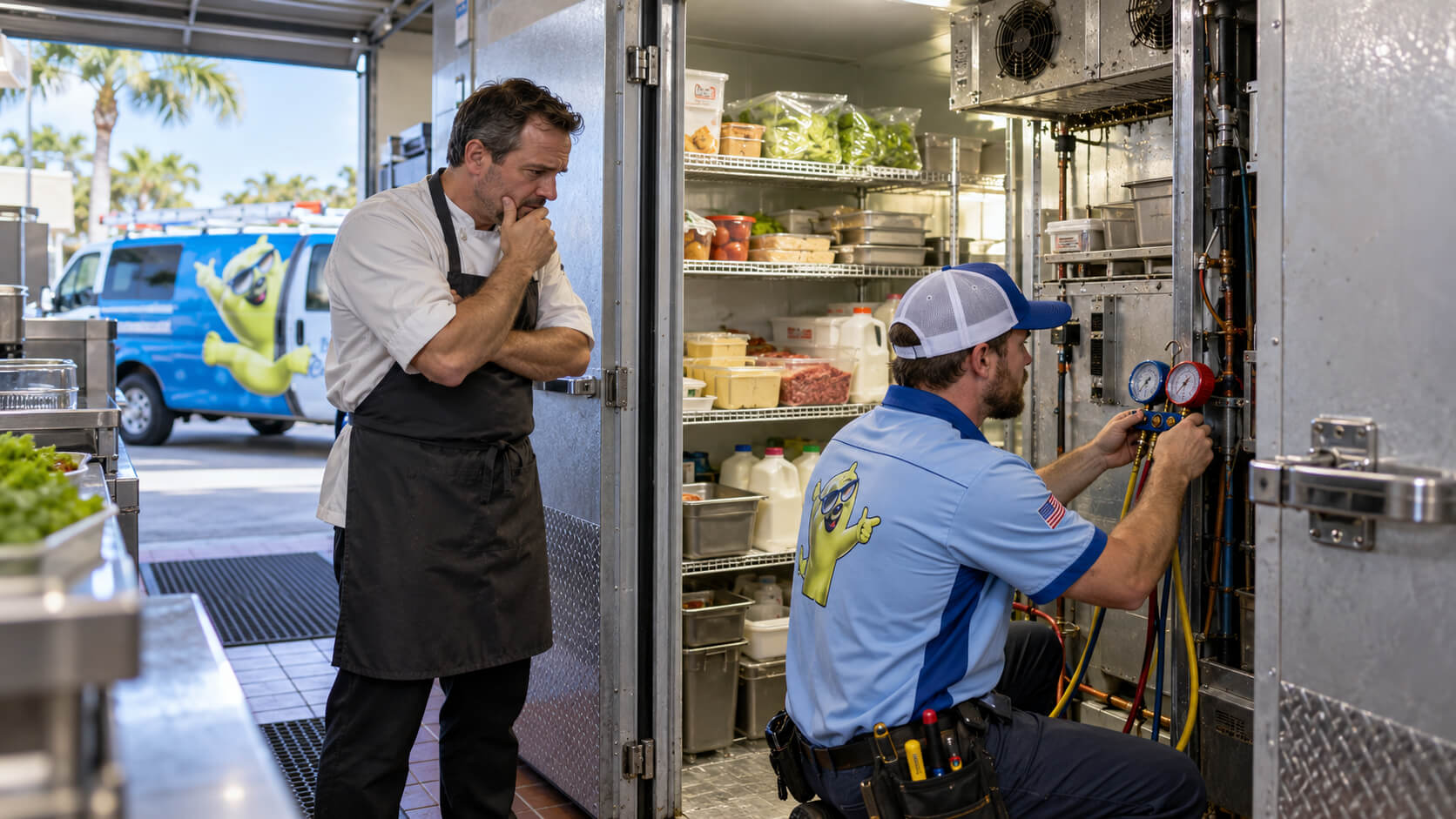
A walk in cooler not cooling in Florida can quickly become more than an equipment problem.
Restaurants, hotels, schools, commercial kitchens, and food service businesses depend on refrigeration to protect inventory and maintain normal operations.
When cooler temperatures begin rising, the priority is to protect the product while determining what has failed.
All In One AC provides commercial HVAC and refrigeration services for Florida businesses.
Table of Contents
What Temperature Should a Walk In Cooler Maintain?
Businesses handling temperature-sensitive foods should follow applicable food safety requirements.
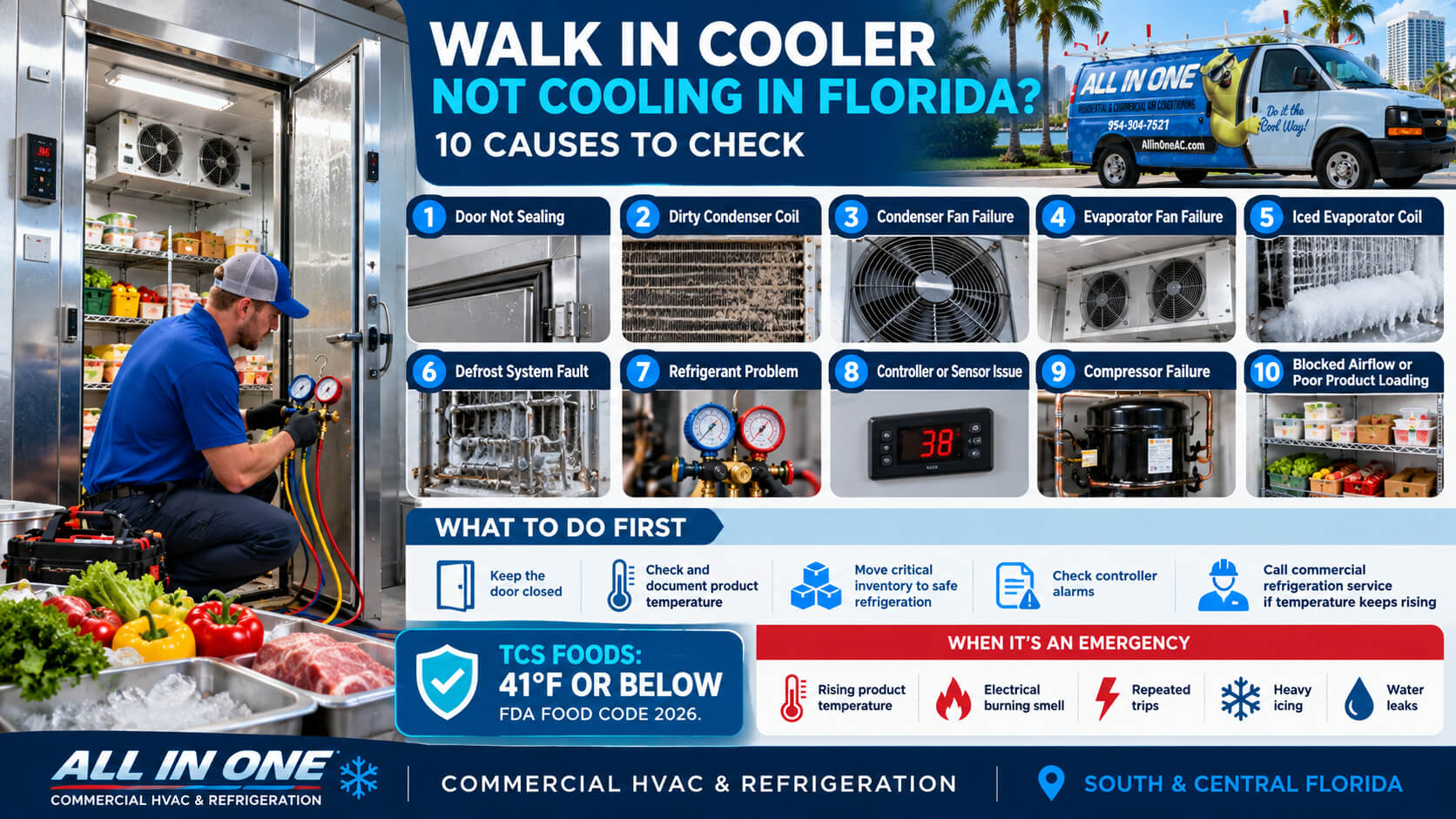
For time/temperature control for safety (TCS) foods, 41°F (5°C) or below is the general cold-holding standard in the FDA Food Code. Follow applicable Florida rules and your food safety plan, including any specific exceptions or corrective actions.
Do not rely only on the cooler controller.
Check actual food temperatures according to your food safety procedures.
Walk In Cooler Not Cooling in Florida: Safe First Steps
If temperatures are rising:
- Keep the cooler door closed.
- Document the current temperature.
- Move high-risk products to safe refrigeration if needed.
- Check for alarms.
- Confirm the temperature set point.
- Listen for fans and refrigeration equipment.
- Look for ice or leaking water.
- Call for refrigeration service if temperatures continue increasing.
1. The Door Is Not Sealing Properly
Hot, humid Florida air entering a walk in cooler adds a significant cooling load.
Check for:
- Damaged gaskets
- Misaligned doors
- Broken hinges
- Product blocking the door
- Excessive employee traffic
Poor door sealing can also contribute to evaporator icing.
2. The Condenser Coil Is Dirty
Commercial kitchens contain grease, dust, and airborne debris.
A dirty condenser cannot release heat efficiently.
The refrigeration system may then run longer and struggle to maintain temperature.
3. The Condenser Fan Has Failed
The condenser fan moves air across the condenser coil.
If it stops, refrigeration pressures and temperatures can move outside normal operating conditions.
Professional electrical diagnosis may be required.
4. The Evaporator Fan Is Not Working
Evaporator fans circulate cold air throughout the cooler.
When one fails, cooling may become uneven.
Signs include:
- Weak internal airflow
- Quiet evaporator section
- Warm areas
- Heavy ice
- Long compressor runtime
5. The Evaporator Coil Is Iced Over
Heavy ice can block airflow through the evaporator.
Possible causes include:
- Door infiltration
- Defrost faults
- Fan problems
- Refrigerant issues
- Drain problems
- Sensor failures
Removing the ice alone is not a complete repair.
6. The Defrost System Is Malfunctioning
Defrost systems control ice accumulation.
Possible failures include:
- Defrost heaters
- Controllers
- Sensors
- Timers
- Termination devices
A failed defrost system can eventually cover the evaporator with ice.
7. There Is a Refrigerant Problem
Low refrigerant, leaks, restrictions, or metering device issues may reduce cooling capacity.
Possible symptoms include:
- Long runtime
- Poor temperature recovery
- Icing
- Abnormal frost patterns
- Difficulty reaching set point
8. The Temperature Sensor or Controller Is Incorrect
A failed sensor may report the wrong temperature.
A controller problem may prevent equipment from operating correctly.
Technicians can compare actual operating conditions against the controller data.
9. The Compressor Is Failing
Compressor problems may result in:
- Poor cooling
- No cooling
- Electrical trips
- Hard starting
- Abnormal noise
- High electrical current
The entire refrigeration system should be evaluated before a compressor replacement is recommended.
10. Product Is Blocking Airflow
Cold air needs room to circulate.
Problems occur when:
- Boxes block the evaporator
- Product is stacked against supply airflow
- Shelving blocks return airflow
- Large quantities of warm food are loaded at once
Correct product placement supports consistent temperature throughout the cooler.
When a Walk In Cooler Failure Is an Emergency
Act quickly when:
- Food temperatures continue rising
- The cooler cannot reach set point
- Electrical components smell burned
- The compressor repeatedly trips
- Heavy ice covers the evaporator
- Water leaks onto the floor
- Large amounts of inventory are at risk
Repair or Replace a Walk In Cooler?
Repair may be appropriate when the refrigeration system is generally in good condition and the failure is isolated.
Replacement may deserve consideration when:
- Major failures repeat
- Parts are becoming difficult to obtain
- Compressor problems continue
- Refrigerant problems are frequent
- Equipment condition is poor
- Capacity no longer matches the business
- Energy performance has declined substantially
Preventative Commercial Refrigeration Maintenance
Maintenance may include:
- Condenser inspection
- Coil cleaning
- Evaporator inspection
- Fan checks
- Door gasket inspection
- Drain inspection
- Electrical testing
- Refrigerant performance checks
- Temperature control testing
- Defrost verification
Commercial refrigeration runs around the clock, making preventative maintenance especially important.
FAQs
Why is my walk in cooler running but not getting cold?
Possible causes include condenser problems, fan failures, iced evaporators, refrigerant issues, sensor faults, blocked airflow, or compressor failure.
What should a restaurant do when its cooler starts warming?
Keep the door closed, document product temperature, protect inventory, and arrange refrigeration service if temperature continues rising.
Why does a walk in cooler evaporator freeze?
Door leakage, fan problems, defrost faults, high humidity, refrigerant problems, and control failures can all contribute.
Is 45°F cold enough for food storage?
Temperature-sensitive foods commonly require colder storage. Follow applicable regulations and food safety procedures, including the 41°F cold-holding benchmark for TCS foods.
Conclusion
A walk in cooler not cooling in Florida can quickly affect food safety, inventory, and business operations.
Keep the door closed, protect temperature-sensitive products, record temperatures, and avoid repeatedly resetting equipment without knowing the problem.
If you have a walk in cooler not cooling in Florida, a complete equipment assessment can identify whether the issue involves air circulation, the defrost system, controls, refrigerant performance, or a failing component. All In One AC provides commercial HVAC and refrigeration troubleshooting for Florida businesses that depend on reliable walk in cooler and freezer performance. Contact our team to discuss your commercial refrigeration service needs.
 Heading Sub Title
Leave a Reply