

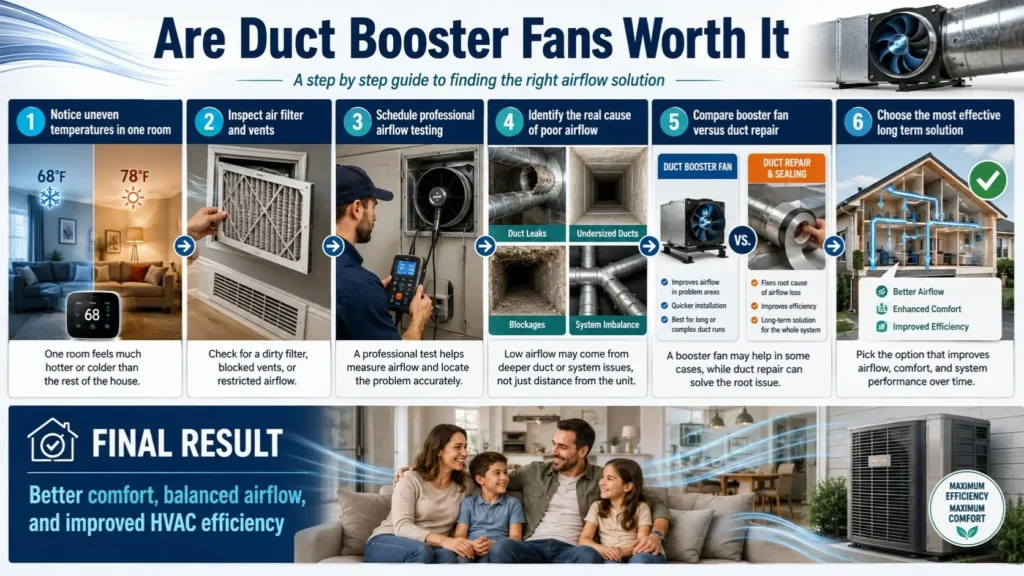
Are duct booster fans worth it? The short answer is yes, but only in the right situation. These small devices can improve airflow to rooms that never seem to reach the same temperature as the rest of the house. They are not a magic fix for every heating and cooling problem, though. If your HVAC system has deeper issues such as leaking ducts, an undersized unit, or poor duct design, a booster fan alone will not solve the problem.
Many homeowners in South Florida experience this frustration. One bedroom feels like a refrigerator while another feels warm no matter how low the thermostat is set. I’ve heard people say they keep adjusting the thermostat throughout the day, hoping something changes, only to realize the airflow itself is the real issue. It is surprising how often uneven airflow causes unnecessary discomfort and higher energy bills.
This guide explains how duct booster fans work, when they are worth the investment, when they are not, and how All In One AC helps homeowners find the right solution instead of wasting money on temporary fixes.
Table of Contents
What Is a Duct Booster Fan?
A duct booster fan is a small electric fan installed inside or connected to your HVAC ductwork. Its job is simple. It increases airflow through a particular duct so more conditioned air reaches rooms that receive weak airflow.
Unlike your HVAC blower motor, which pushes air through the entire duct system, a duct booster fan only assists airflow in one specific section of the ductwork.
Most homeowners install them because of:
- Upstairs rooms staying warmer than downstairs
- Bedrooms far from the air handler
- Home additions with weak airflow
- Rooms with long duct runs
- Uneven temperatures throughout the home
A booster fan does not create cold air. It only helps move the air your HVAC system is already producing.
Quick Facts About Duct Booster Fans
| Feature | Details |
| Primary Purpose | Improve airflow to specific rooms |
| Installation Location | Inside or attached to existing ductwork |
| Best For | Minor airflow problems |
| Average Lifespan | Several years with proper maintenance |
| Main Benefit | More balanced indoor temperatures |
How Does a Duct Booster Fan Work?
Your HVAC system depends on balanced airflow. When air has difficulty reaching certain areas, those rooms stay warmer or cooler than the rest of the house.
A duct booster fan activates whenever your HVAC system begins running. Some models switch on automatically through pressure sensors, while others connect directly to your thermostat or electrical system.
Once operating, the fan pulls additional air through that section of ductwork, helping overcome resistance created by long ducts, bends, or partially restricted airflow.
Think of it like adding a helper to move air farther through the duct system instead of asking the main blower to do all the work alone.
Signs You Might Need a Duct Booster Fan
Not every uncomfortable room requires expensive HVAC repairs.
Sometimes the problem is limited to one area.
You may benefit from a duct booster fan if you notice:
- One room always feels warmer than the rest
- Upstairs never cools properly
- Air coming from one vent feels much weaker
- Long hallways receive little airflow
- New home additions never reach the thermostat setting
- Your HVAC system otherwise works normally
If several rooms have poor airflow, the issue is probably much larger than one booster fan can solve.
Common Reasons for Weak Airflow
Poor airflow rarely happens without a reason.
Some of the most common causes include:
Long Duct Runs
The farther air travels, the more pressure it loses.
Large homes often experience this issue.
Poor Duct Design
Older homes sometimes have duct layouts that simply were not designed efficiently.
Sharp turns and unnecessary bends reduce airflow.
Dirty Air Filters
This is easier to overlook than people realize.
A clogged filter restricts airflow throughout the entire system.
I have seen homeowners worry about replacing their entire HVAC system only to discover the filter had not been changed in months. That is always a relief because the solution is simple.
Leaky Ductwork
According to the United States Department of Energy, poorly sealed ducts can lose a significant portion of conditioned air before it ever reaches your living space.
Undersized HVAC Equipment
If your air conditioner is too small for your home, no booster fan can compensate for insufficient cooling capacity.
Are Duct Booster Fans Really Worth It?
The answer depends entirely on why your airflow problem exists.
They work well when:
- Your HVAC system is properly sized.
- The duct system is mostly in good condition.
- Only one or two rooms have airflow issues.
- The problem is caused by distance rather than equipment failure.
They are usually not worth buying if:
- Your ducts leak extensively.
- Your HVAC system is old and failing.
- Your blower motor has problems.
- Multiple rooms have airflow issues.
- Your air conditioner is improperly sized.
Installing a booster fan without diagnosing the real issue can become an expensive guessing game.
That is why professional airflow testing is often the smarter first step.
Benefits of Installing a Duct Booster Fan
Many homeowners notice meaningful improvements after installation.
Some advantages include:
- Better airflow
- Improved comfort
- More even temperatures
- Less strain on occupants constantly adjusting thermostats
- Better use of conditioned air
- Lower frustration with hot spots
A properly selected booster fan can improve comfort without replacing your entire HVAC system.
Potential Drawbacks
Every solution has limitations.
A duct booster fan also comes with a few disadvantages.
Some models create additional operating noise.
They also consume electricity, although usually very little.
Installation can become complicated if duct access is limited.
Most importantly, they cannot repair damaged ducts, failing equipment, or incorrect HVAC sizing.
That is why treating symptoms instead of identifying the actual cause often leads to disappointment.
Here is the comparison information formatted as a clean, easy-to-read Markdown table:
Duct Booster Fans Versus Other Solutions
| Solution | Best For | Long Term Value |
| Duct Booster Fan | One room with weak airflow | Good |
| Duct Sealing | Air leaks | Excellent |
| Duct Cleaning | Dust and restricted airflow | Very Good |
| HVAC Replacement | Old inefficient systems | Excellent |
| Duct Redesign | Poor airflow throughout home | Excellent |
How All In One AC Compares to Other Solutions
Choosing the right fix for uneven airflow is just as important as identifying the problem. Some companies immediately recommend replacing the entire HVAC system, while others install a booster fan without investigating the root cause. Neither approach is ideal.
At All In One AC, every service begins with a complete inspection of your cooling system, ductwork, air pressure, and airflow patterns. This helps determine whether a duct booster fan is the right investment or if another solution will deliver better long-term results.
For example, if the issue is a clogged air filter, a leaking duct, or an oversized air conditioner that short cycles, installing a booster fan would only mask the symptoms. On the other hand, if one room is located far from the air handler and the rest of the home cools properly, a booster fan may be a practical and cost-effective solution.
Instead of relying on guesswork, professional airflow testing provides clear answers.
Professional Installation Versus DIY
Many duct booster fans are marketed as easy to install, which encourages homeowners to handle the project themselves. While some plug-in register fans are simple to set up, inline duct booster fans require more planning.
Professional installation offers several advantages.
A technician can verify that the fan is correctly sized for the duct.
Electrical connections are completed safely.
Airflow is tested before and after installation.
The system remains balanced without creating pressure problems in other rooms.
Warranty protection is also less likely to be affected when the work is completed correctly.
DIY installation can work for basic register booster fans, but cutting into ductwork or modifying HVAC components without experience may create new airflow problems.
Can a Booster Fan Reduce Energy Bills?
This is one of the most common questions homeowners ask.
The answer depends on why your airflow problem exists.
If one room never cools properly, many people lower the thermostat several degrees to make that room comfortable. Unfortunately, this forces the entire HVAC system to run longer, increasing electricity use.
A properly installed booster fan may improve airflow enough that the thermostat no longer needs constant adjustment.
However, if the system itself is inefficient, leaking air, or nearing the end of its lifespan, a booster fan alone is unlikely to create noticeable energy savings.
According to the United States Department of Energy, heating and cooling account for roughly 43 percent of the average home’s utility bill in many parts of the United States, making HVAC efficiency one of the largest opportunities for reducing energy costs.
The United States Department of Energy also reports that sealing and insulating ductwork can significantly improve HVAC performance in homes with leaky ducts.
These findings highlight an important point.
Sometimes fixing the ducts produces greater savings than installing additional equipment.
Best Practices Before Buying Duct Booster Fans
If you are considering adding duct booster fans, take a few simple steps first.
- Replace your HVAC air filter.
- Make sure every supply vent is fully open.
- Check for blocked return air vents.
- Inspect visible ductwork for disconnected sections.
- Schedule a professional airflow inspection.
- Verify that your HVAC system is properly sized.
- Consider duct sealing if leaks are discovered.
These basic steps often solve airflow problems without purchasing additional equipment.
Common Mistakes Homeowners Make
Many airflow problems become more expensive because people focus on symptoms instead of causes.
Some of the most common mistakes include:
- Buying the largest duct booster fans available without checking duct size.
- Ignoring dirty evaporator coils.
- Closing supply vents in unused rooms.
- Blocking return vents with furniture.
- Replacing an HVAC system before inspecting the ductwork.
- Assuming every hot room needs duct booster fans.
One mistake often leads to another. A room feels warm, the thermostat gets lowered, the system runs longer, and electricity bills continue climbing without solving the original issue.
When a Duct Booster Fan Is Not the Right Solution
Although duct booster fans can improve comfort, they have limits.
You may need a different solution if:
- Several rooms have airflow problems.
- Your HVAC equipment is more than fifteen years old.
- Your air conditioner constantly runs without reaching the thermostat setting.
- Airflow is weak throughout the entire house.
- Your ductwork has major leaks or poor design.
In these situations, repairing or redesigning the duct system often provides better long-term value.
Statistics Every Homeowner Should Know
Reliable information helps homeowners make smarter HVAC decisions.
According to the United States Department of Energy, heating and cooling account for about 43 percent of residential energy use, making HVAC efficiency one of the biggest contributors to household utility costs.
The United States Environmental Protection Agency Energy Star Program states that regular HVAC maintenance helps systems operate more efficiently while extending equipment life.
Research from the National Air Duct Cleaners Association explains that restricted airflow from dirty HVAC components can reduce system performance and indoor comfort.
The Air Conditioning Contractors of America recommends proper HVAC sizing instead of simply installing larger equipment, since oversized systems often create humidity and airflow problems.
These organizations consistently emphasize one message.
Proper diagnosis should always come before purchasing additional HVAC equipment.
Key Takeaways
- Duct booster fans improve airflow but do not create additional cooling.
- They work best when only one or two rooms experience weak airflow.
- They cannot repair leaking ducts or failing HVAC equipment.
- Professional airflow testing helps determine whether duct booster fans are actually needed.
- Regular maintenance, duct inspections, and proper HVAC sizing remain the best long-term investments.
- All In One AC helps homeowners identify the real cause of uneven cooling before recommending repairs.
FAQs
Q1. Do duct booster fans really work?
Yes. They can improve airflow to rooms with weak air delivery when the HVAC system is otherwise operating correctly.
Q2. Can a booster fan damage my HVAC system?
When properly selected and professionally installed, duct booster fans generally do not damage HVAC systems. Incorrect installation, however, can affect airflow balance.
Q3. How long do duct booster fans last?
Most quality models last several years, depending on usage, installation quality, and maintenance.
Q4. Will duct booster fans cool my entire house?
No. It is designed to improve airflow to a specific area rather than increase cooling capacity throughout the home.
Q5. Should I install a booster fan myself?
Simple register duct booster fans are often homeowner-friendly. Inline duct booster fans are better installed by experienced HVAC professionals.
Final Thoughts
If you have been asking yourself, “Are duct booster fans worth it?”, the answer depends on what is causing your airflow problem. For homes with one difficult room and an otherwise healthy HVAC system, duct booster fans can make a noticeable difference in comfort. However, it should never replace a proper inspection when the issue is caused by leaking ducts, poor system design, or aging equipment.
That is where professional guidance becomes valuable. Instead of guessing or spending money on a solution that may not address the real problem, All In One AC performs a complete evaluation of your HVAC system, ductwork, and airflow before making recommendations. This honest approach helps homeowners invest in solutions that improve comfort, increase efficiency, and reduce unnecessary repair costs over time.
Sometimes duct booster fans are exactly what your home needs. Other times, fixing the underlying issue delivers far better results. Knowing the difference can save you money and keep your home comfortable throughout every Florida season.
Leave a Reply