
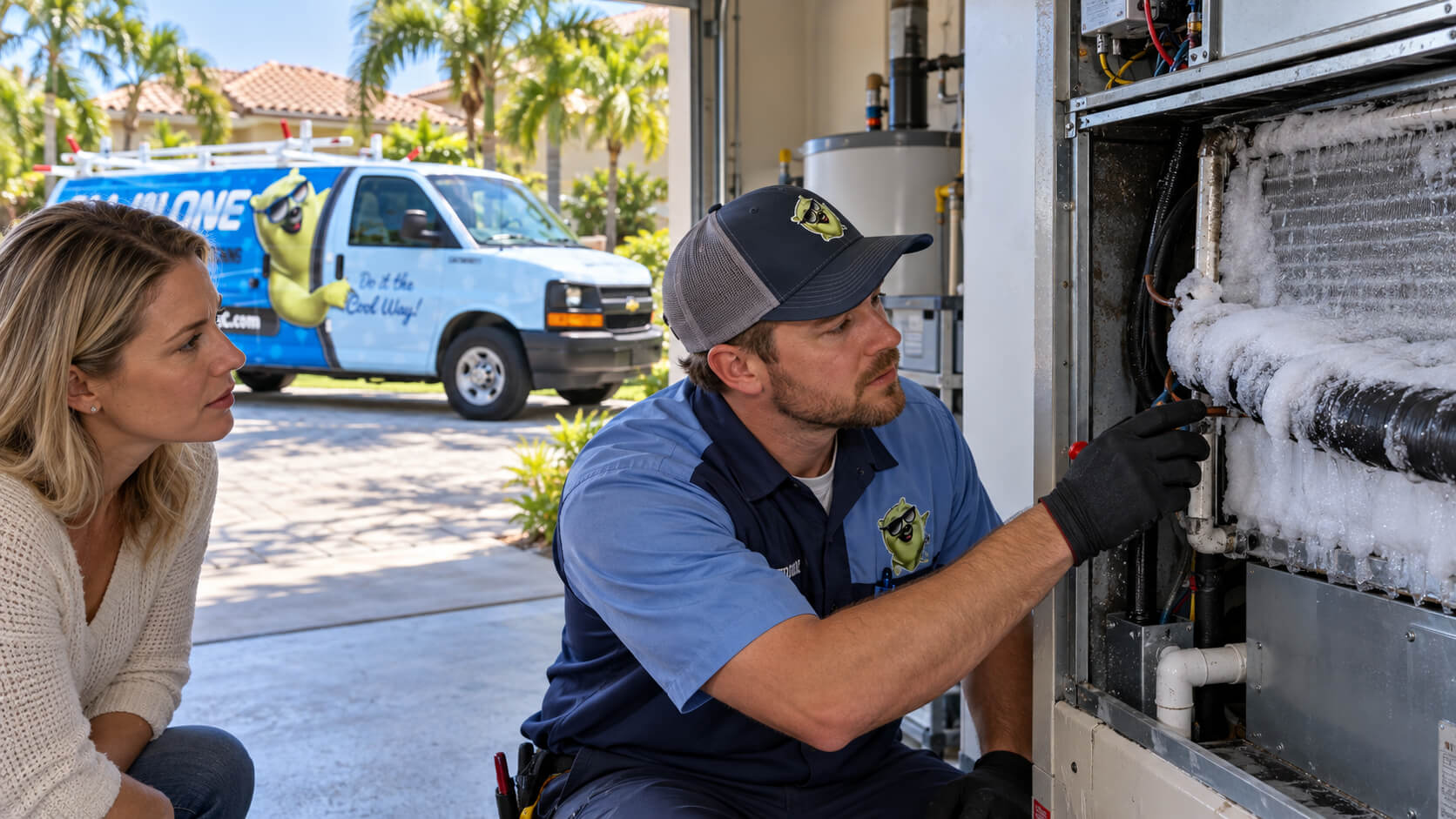
Finding Ice on the AC Unit Inside your home can be confusing. Air conditioners are built to create cool air, so seeing ice may initially seem harmless.
It is not.
A correctly operating residential AC system should not develop a thick layer of frost or ice around its indoor components.
Ice usually indicates that the evaporator coil has dropped below its normal operating temperature because heat transfer, airflow, refrigerant pressure, or another part of the cooling process is not working correctly.
In Florida, where cooling equipment may operate for long stretches, ignoring the warning can quickly lead to loss of comfort and additional strain on the HVAC system.
All In One AC provides professional AC repair for homeowners and businesses experiencing freezing, poor cooling, airflow problems, and other HVAC faults.
Table of Contents
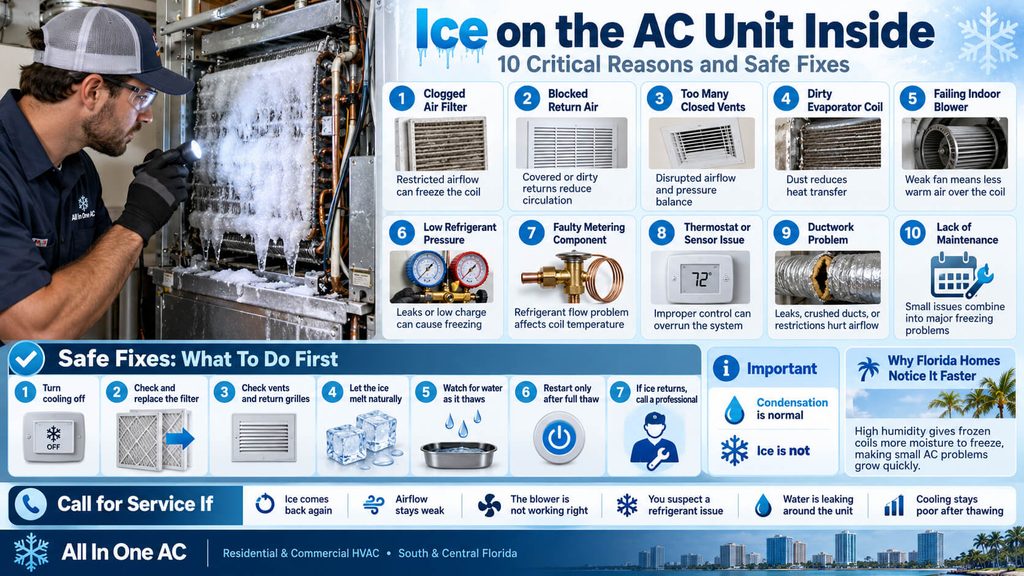
Here are 10 reasons you may be seeing ice inside your air conditioning system:
1. The Air Filter Has Become Severely Clogged
Start with the simple things.
A dirty filter can restrict the volume of warm indoor air reaching the evaporator coil.
When airflow falls enough, the coil may become excessively cold and moisture on its surface can freeze.
Safe Check
Turn the cooling system off and inspect the filter.
If it is obviously dirty, replace it with an appropriate filter for the system.
After the ice has fully melted, monitor system performance.
If ice begins returning, there is probably another issue involved.
2. The Return Air Path Is Blocked
The AC cannot circulate air properly if return grilles are covered.
Common problems include:
- Furniture pushed against return grilles
- Decorative objects blocking airflow
- Extremely dirty return grilles
- Undersized return pathways
- Closed interior doors affecting circulation in certain layouts
Restricted return airflow can reduce the heat moving across the evaporator coil.
The result can be Ice on the AC Unit Inside, weak airflow, and poor cooling.
3. Too Many Supply Vents Have Been Closed
Closing a vent in one unused room may not immediately create a serious problem, but closing many registers throughout the house can interfere with system airflow and pressure.
Central HVAC systems are designed around a particular airflow pattern.
Instead of trying to redirect most of the cooling by shutting registers, keep vents open unless an HVAC professional has designed the system to operate differently.
4. The Evaporator Coil Is Covered With Dirt
Dust on the coil creates a layer between the air and the cold metal surface.
That reduces heat transfer.
The coil may still contain cold refrigerant, but it cannot absorb indoor heat as effectively.
Eventually, moisture can freeze.
A proper maintenance visit may include inspection of the coil, blower, drain, electrical components, temperature performance, and airflow.
Homeowners looking to reduce preventable cooling issues can use the Florida AC maintenance checklist as a starting point.
5. The Indoor Blower Is Failing
Your indoor fan is not simply there to push cool air into rooms.
It is an essential part of the refrigeration process because it keeps warm indoor air moving over the evaporator coil.
When the blower is weak or stops, the coil can quickly become too cold.
Potential blower problems include:
- Motor failure
- Electrical fault
- Control problem
- Dirty blower wheel
- Incorrect speed
- Variable-speed communication fault
If your vents suddenly have very little airflow while the outdoor equipment continues operating, turn the system off and arrange an inspection.
6. Refrigerant Pressure Is Too Low
Low refrigerant often means refrigerant has escaped from somewhere in the sealed system.
Changing pressure conditions can cause the evaporator coil to operate outside its intended range and freeze.
You may notice:
- Ice on copper tubing
- Poor cooling
- Longer cooling cycles
- Rising indoor humidity
- Repeated freezing after thawing
Refrigerant issues require proper tools and training.
A technician should evaluate the operating conditions instead of simply adding refrigerant without understanding why the charge is low.
7. A Refrigerant Control Component Is Malfunctioning
Refrigerant must enter the evaporator coil at the correct rate.
A problem with a thermostatic expansion valve or another metering component can interfere with that process.
Because symptoms may look similar to low refrigerant or airflow failure, accurate diagnosis requires measurements rather than guessing.
This is one reason repeated indoor icing should be inspected professionally.
8. The Thermostat or Sensor Is Not Controlling the System Properly
A thermostat sends operating commands to the cooling system.
A defective temperature sensor, communication problem, incorrect thermostat configuration, or poorly located thermostat can affect how long the AC operates.
Long and abnormal operation can make an existing airflow or refrigeration problem more noticeable.
Before assuming the thermostat is bad, check that it is:
- Set to cooling
- Reading a reasonable indoor temperature
- Not exposed to unusual heat sources
- Not being forced to an unnecessarily extreme set point
9. The Ductwork Has a Significant Problem
Airflow restrictions are not limited to the air handler.
Damaged ducts can alter system performance.
Possible problems include:
- Crushed flexible ducts
- Disconnected sections
- Heavy leakage
- Poorly designed return ducts
- Internal obstruction
- Incorrect duct sizing
One clue is uneven airflow throughout the house.
If one area receives strong airflow while several other rooms barely receive air, a duct inspection may be worthwhile.
10. The System Has Been Operating Without Adequate Maintenance
A frozen AC is sometimes the result of several smaller issues happening together.
A slightly dirty filter, dusty coil, weakening blower component, and drainage problem may not each stop the system immediately.
Combined, however, they can produce poor performance.
Preventative service is designed to find these developing problems before they become emergency failures.
All In One AC provides repair and maintenance for residential systems as well as commercial HVAC systems.
Where Does the Ice Usually Appear?
When homeowners describe Ice on the AC Unit Inside, they may be referring to different parts of the system.
Ice can appear on:
- Evaporator coil
- Copper refrigerant tubing
- Suction line
- Coil cabinet
- Air handler components
- Areas close to the indoor unit
The visible location of the ice can provide clues, but it does not automatically identify the root cause.
What Should You Do When You See Ice?
Step 1: Stop Cooling
Turn the thermostat out of cooling mode.
Continuing to run the compressor can increase system strain.
Step 2: Check the Filter
Replace a dirty filter if needed.
Step 3: Check Vents and Returns
Make sure furniture or household objects are not blocking airflow.
Step 4: Let the Ice Melt
Do not attempt to break the ice away manually.
Allow the system to thaw.
Step 5: Watch for Water
Ice can create a substantial amount of water as it melts.
Protect nearby floors and watch for overflowing drain pans or unusual leakage.
Step 6: Restart Only After Thawing
Once the system is completely thawed, it may be restarted if there is no electrical, blower, or water-related reason to leave it off.
Monitor airflow and cooling carefully.
Step 7: Turn It Back Off if Ice Returns
Repeated freezing means the underlying fault remains.
That is the point at which professional troubleshooting is usually the more sensible option.
Ice Versus Condensation: What Is Normal?
Moisture is a normal part of air conditioning.
The evaporator coil cools humid indoor air, causing water vapor to condense on the coil. That water should flow into the condensate pan and drain away.
Condensation is expected.
Ice is not.
Seeing normal drain water does not mean the AC is malfunctioning, but frost covering refrigerant tubing or the evaporator area deserves attention.
Why High Humidity Makes the Problem More Noticeable
Florida air can contain a significant amount of moisture.
When an evaporator coil becomes abnormally cold, there is plenty of moisture available to freeze onto it.
This can allow a relatively small performance issue to turn into a substantial ice buildup.
Good HVAC operation in South Florida therefore involves more than simply producing cold air. Proper airflow and humidity control matter as well.
When Should You Call All In One AC?
Professional service is recommended when:
- The system freezes more than once
- A clean filter does not solve the problem
- Airflow remains weak
- The blower is not operating correctly
- You suspect a refrigerant problem
- Water is leaking around the air handler
- The breaker repeatedly trips
- Cooling performance remains poor after thawing
- Strange noises appear
- You are unsure why the system froze
All In One AC focuses on determining the cause rather than simply removing visible ice.
For additional information on repair and maintenance questions, visit the HVAC FAQ.
How to Prevent Ice From Returning
Maintain Good Airflow
Do not block return grilles and avoid closing large numbers of supply registers.
Replace Filters When Needed
Filter condition should be checked regularly, especially during months of heavy AC use.
Pay Attention to Performance Changes
Weak airflow and long cooling cycles often appear before a complete failure.
Keep the System Maintained
Preventative inspections can identify dirty coils, developing blower problems, electrical wear, drainage issues, and other concerns.
Repair Refrigerant Problems Properly
If refrigerant is low because of a leak, the underlying issue should be evaluated rather than relying on repeated temporary recharging.
Why Choose All In One AC for Frozen AC Problems?
All In One AC serves residential and commercial properties across South and Central Florida.
The company handles:
- Air conditioner repair
- HVAC installation
- Preventative maintenance
- Rooftop systems
- Commercial HVAC
- Ductwork
- Refrigeration
- System replacement
That broader mechanical experience is useful when a frozen indoor AC turns out to involve more than a filter.
Learn more about Our HVAC experience.
Conclusion
Ice on the AC Unit Inside should never be treated as proof that the air conditioner is cooling especially well.
It normally means something has interfered with the heat-transfer process.
A dirty filter or blocked vent may be easy to correct. A failing blower, refrigerant leak, metering problem, control fault, or duct issue requires a more detailed diagnosis.
Turn cooling off, allow the system to thaw naturally, check the safe basics, and pay attention after restarting it.
If the ice comes back, professional service is the better next step.
You can contact us for HVAC troubleshooting and repair throughout the company’s Florida service areas.
FAQs
1. Is Ice on the AC Unit Inside dangerous for the system?
It can become damaging if the AC continues operating while frozen. Ice restricts airflow and can place unnecessary stress on the cooling system, which is why the unit should be allowed to thaw and the cause should be identified.
2. How long should I leave a frozen AC turned off?
There is no single thawing time for every system. The amount of ice, airflow, indoor temperature, and humidity all affect the process. Do not restart cooling until the ice has completely melted.
3. Why does my indoor AC keep freezing after I change the filter?
The filter may not be the root cause. Repeated freezing can indicate a dirty coil, blower problem, duct restriction, low refrigerant, metering-device problem, or another HVAC fault.
 Heading Sub Title
Leave a Reply