
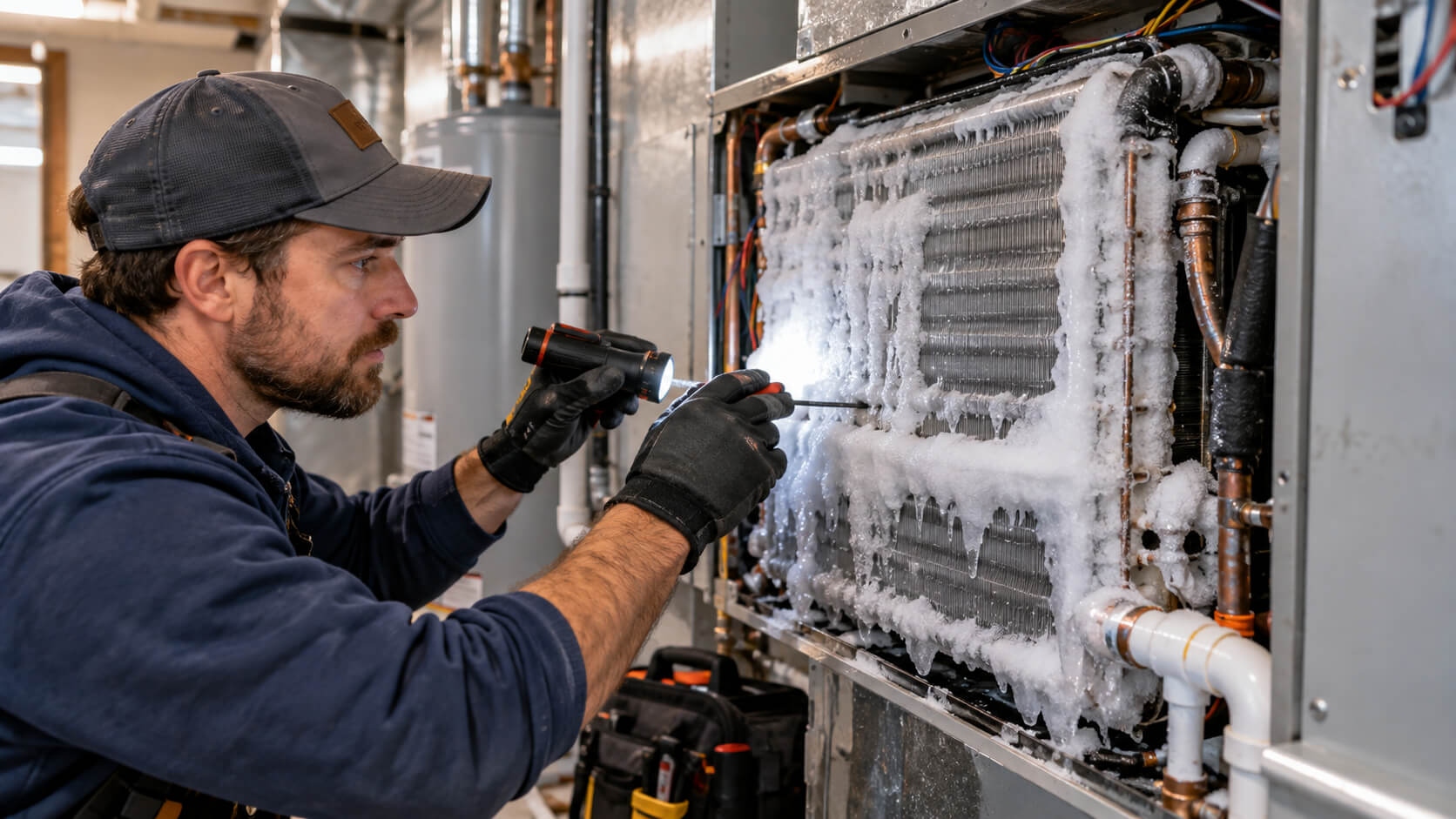
An Air conditioner evaporator coil frozen problem can turn a normal Florida afternoon into an uncomfortable one surprisingly quickly. Your air conditioner may continue running, but airflow becomes weak, rooms stop cooling properly, and ice may begin forming around the indoor coil or refrigerant line.
The ice itself is rarely the real problem. It is usually a symptom of an airflow, refrigerant, control, or mechanical issue somewhere in the HVAC system.
That distinction matters. Simply melting the ice without identifying why it formed can leave you dealing with the same frozen coil again a few hours or days later.
At All In One AC, we focus on finding the reason a cooling system is struggling rather than treating only the visible symptom. This guide explains ten common causes of a frozen evaporator coil, what homeowners can safely check, and when professional diagnosis makes more sense.
Table of Contents
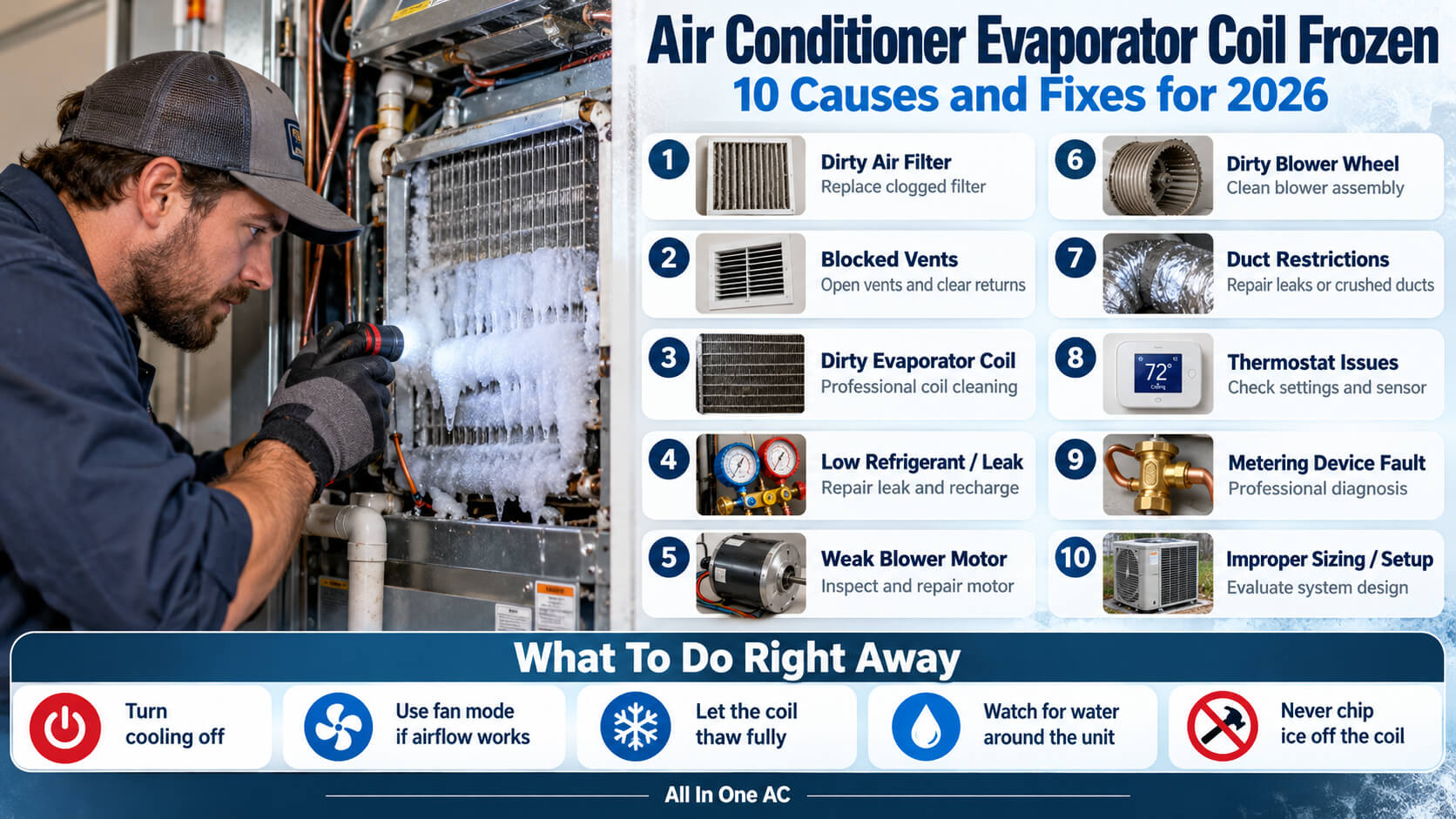
What Does the Evaporator Coil Actually Do?
The evaporator coil is located inside the indoor section of a central air conditioning system.
Refrigerant flowing through the coil absorbs heat from indoor air. The blower then moves cooled air through the duct system and back into your home.
For that process to work correctly, the coil needs:
- Adequate airflow
- Correct refrigerant pressure
- A properly functioning blower
- Clean heat transfer surfaces
- Correct controls and system operation
When one of those conditions changes significantly, the temperature of the evaporator coil can fall below freezing.
Moisture that normally condenses on the coil then turns to ice.
As ice builds, airflow becomes even more restricted. That creates a cycle in which the coil becomes increasingly frozen while the house becomes less comfortable.
Signs Your Evaporator Coil May Be Frozen
An Air conditioner evaporator coil frozen issue does not always begin with a large visible block of ice.
Early warning signs may include:
- Weak airflow from supply vents
- AC running for unusually long periods
- Warm or room temperature air from vents
- Frost on refrigerant tubing
- Water near the indoor air handler
- Unusual changes in humidity
- Cooling that gradually becomes worse
- Indoor fan running without effective cooling
If the symptoms continue after basic checks, professional AC repair in Coral Springs can help determine whether the problem involves airflow, refrigerant, electrical components, or another system fault.

1. A Dirty Air Filter Is Restricting Airflow
One of the simplest causes is also one of the easiest to overlook.
Your air conditioner needs a consistent volume of warm indoor air moving across the evaporator coil. A heavily loaded filter creates resistance and reduces that airflow.
Without enough heat passing over the coil, its temperature can drop too far.
What You Can Do
Turn the cooling system off and inspect the filter.
Replace it if it is visibly dirty or overdue for replacement.
Do not automatically install the thickest or highest-rated filter available. A filter that creates excessive airflow resistance can also be unsuitable for some systems.
If the coil freezes again after a fresh filter is installed, the filter was probably not the only problem.
2. Supply or Return Vents Are Blocked
Furniture, curtains, boxes, rugs, and other household items can interfere with airflow.
Closing too many supply registers can create problems as well.
The HVAC system was designed to move a certain amount of air. Restricting that circulation can affect coil temperature and system pressure.
Walk through the property and make sure return grilles and supply vents have enough open space around them.
If airflow still feels noticeably weaker than normal, a deeper inspection may be required.
3. The Evaporator Coil Is Dirty
An evaporator coil can accumulate dust, debris, and other material over time.
That coating acts like a barrier between the air and the metal surface of the coil.
When the coil cannot absorb heat properly, system performance drops and freezing becomes more likely.
A dirty coil can also contribute to:
- Longer cooling cycles
- Higher operating strain
- Uneven indoor temperatures
- Reduced dehumidification
- Poor overall cooling performance
Professional coil inspection and cleaning are useful parts of a broader AC maintenance routine.
4. Refrigerant Is Low Because of a Leak
Refrigerant is not something an air conditioner should regularly consume.
If the refrigerant charge becomes low, there may be a leak or another problem requiring diagnosis.
Incorrect refrigerant pressure can cause the evaporator coil temperature to fall too low, allowing condensation on the coil to freeze.
Possible signs include:
- Repeated coil freezing
- Weak cooling
- Long run times
- Hissing sounds
- Ice on refrigerant lines
- A noticeable decline in performance
Adding refrigerant without finding the reason for the loss is not a complete repair.
A qualified technician should inspect the system, locate the fault where possible, determine whether repair is practical, and restore the correct operating conditions.
5. The Blower Motor Is Not Moving Enough Air
The indoor blower is responsible for sending air across the evaporator coil and throughout the duct system.
If the blower motor is weak, failing, incorrectly configured, or unable to reach the required speed, airflow may fall below what the system needs.
Blower-related problems may also involve:
- Electrical components
- Motor controls
- Dirty blower wheels
- Wiring
- Capacitors on applicable systems
- Variable-speed control problems
Because these components involve moving parts and electrical systems, professional diagnosis is usually preferable.
6. The Blower Wheel Is Dirty
Even when the blower motor itself works, a heavily contaminated blower wheel can move less air.
Dust accumulating on the blades changes how effectively the wheel moves air through the system.
Homeowners may notice that the fan sounds normal but airflow at the vents feels weaker than it did previously.
This is one reason a complete HVAC inspection involves more than changing the filter.
7. The Duct System Is Restricting Airflow
Sometimes the frozen coil is the result of a problem outside the air handler.
Duct issues can include:
- Collapsed flexible duct
- Disconnected duct sections
- Severe leakage
- Improper duct sizing
- Restricted return airflow
- Damaged or obstructed sections
Florida attics can be particularly demanding environments for ductwork.
If several rooms have weak airflow or large temperature differences, the duct system deserves attention as part of the diagnosis.
8. The Thermostat or Temperature Control Is Causing Excessive Operation
A thermostat problem can cause an air conditioner to operate differently from what the homeowner expects.
Possible issues include:
- Incorrect settings
- Sensor problems
- Poor thermostat location
- Control communication faults
- Extremely aggressive temperature settings
Setting the thermostat dramatically lower does not make the air conditioner cool the house instantly.
It can instead encourage longer operating cycles, especially when the house has a significant heat or humidity load.
A technician can determine whether the thermostat is accurately reading and controlling the system.
9. The Refrigerant Metering Device Is Not Working Correctly
The metering device controls how refrigerant enters the evaporator coil.
A malfunctioning or restricted expansion device can alter refrigerant flow and change the operating conditions inside the coil.
This type of issue is not a reasonable DIY repair.
Technicians may need to evaluate temperature, pressure, airflow, refrigerant charge, and system behavior together before deciding whether the metering device is responsible.
10. The HVAC System Is Improperly Sized or Commissioned
Bigger does not automatically mean better when it comes to HVAC equipment.
A system must be selected and configured according to factors such as:
- Property size
- Heat gain
- Insulation
- Windows
- Occupancy
- Ductwork
- Airflow requirements
- Local climate
- Equipment matching
Improper equipment selection or commissioning can create comfort and humidity problems and may contribute to abnormal operation.
This is particularly important when replacing older equipment with modern variable-capacity systems.
What Should You Do Immediately When the Coil Is Frozen?
If you discover ice, do not continue operating the compressor as though nothing is wrong.
Turn Cooling Off
Switch the thermostat from cooling mode to off.
Continuing to force the system to cool can increase stress on components.
Use Fan Mode When Appropriate
If the blower is operating normally, running the fan without the compressor may help room-temperature air move across the frozen coil.
If the blower itself appears to be the problem, leave the system off and request service.
Allow the Coil to Thaw Completely
Do not restart the system while large amounts of ice remain.
Depending on the amount of ice and indoor conditions, thawing can take time.
Protect the Area From Water
Melting ice may produce more water than you expect.
Watch for water around ceilings, closets, flooring, air handlers, and drain pans.
Never Chip Ice Off the Coil
Do not use knives, screwdrivers, heat guns, or other tools to force the ice off.
Evaporator coil fins and refrigerant tubing can be damaged easily.
Can You Fix a Frozen Evaporator Coil Yourself?
Some basic causes can be addressed safely by a homeowner.
You can usually:
- Replace a dirty filter
- Open blocked vents
- Remove objects covering return grilles
- Turn the system off
- Allow the ice to thaw
- Check basic thermostat settings
You should generally leave refrigerant, electrical, blower, metering-device, and internal mechanical work to trained HVAC professionals.
If freezing returns after the system has thawed, that recurrence is useful diagnostic information.
How All In One AC Diagnoses Repeated Coil Freezing
A proper diagnosis should look beyond the ice.
Depending on the system and symptoms, the inspection may include:
- Filter condition
- Return airflow
- Supply airflow
- Evaporator coil condition
- Blower operation
- Duct condition
- Refrigerant pressures
- Temperature differences
- Electrical components
- Thermostat operation
- Condensate drainage
- Equipment configuration
All In One AC provides residential and commercial HVAC troubleshooting throughout its Florida service areas.
You can review additional common service questions in the HVAC FAQs.
How to Reduce the Chance of Another Frozen Coil
Prevention is mostly about keeping the system operating within its intended conditions.
Check Filters Regularly
Florida cooling systems can operate for long periods, so filters may need more frequent attention than they would in a milder climate.
Keep Vents Open and Unobstructed
Airflow should not be treated as an afterthought.
Schedule Preventative Maintenance
Maintenance gives technicians an opportunity to identify dirty components, drainage issues, weak airflow, electrical wear, and developing performance problems before the system completely stops cooling.
Respond to Weak Airflow Early
A gradual decline in airflow deserves investigation.
Waiting until the coil becomes a block of ice can turn a smaller problem into a more disruptive service call.
Watch for Repeat Symptoms
One isolated freeze related to an extremely dirty filter may be straightforward.
Repeated freezing after the filter is replaced is a different situation and should be diagnosed professionally.
Why Florida Homes Need Special Attention
South Florida cooling systems operate in a hot and humid environment for much of the year.
That means an AC system must handle both sensible heat and moisture.
When airflow or refrigeration performance is compromised, the effect can show up quickly through poor cooling, rising humidity, long cycles, and frozen coils.
All In One AC works with residential and commercial HVAC systems across South and Central Florida and understands the importance of reliable cooling under demanding local conditions.
Conclusion
An Air conditioner evaporator coil frozen problem should be treated as a warning rather than simply an inconvenience.
A dirty filter may be responsible, but frozen coils can also point to blocked airflow, dirty components, blower problems, duct restrictions, refrigerant leaks, thermostat faults, or incorrect system operation.
Turn the cooling system off, allow the coil to thaw, make the safe basic checks, and pay close attention to what happens after restarting it.
If ice returns, the system needs more than another temporary thaw.
All In One AC can inspect the complete cooling system, identify the underlying problem, and recommend an appropriate repair or maintenance solution.
For professional assistance, contact us.
FAQs
1. Why is my air conditioner evaporator coil frozen?
Common causes include restricted airflow, a dirty filter, a dirty evaporator coil, blower problems, duct restrictions, low refrigerant caused by a leak, or control problems. Proper diagnosis is important because several faults can produce similar symptoms.
2. Can I run my AC while the evaporator coil is frozen?
It is generally better to turn cooling off and allow the coil to thaw. Continuing to operate a malfunctioning frozen system can place unnecessary strain on HVAC components.
3. Will replacing the filter fix a frozen evaporator coil?
It can if a badly clogged filter was the only cause. If the coil freezes again after a clean filter is installed and airflow is unobstructed, professional inspection is recommended.
 Heading Sub Title
Leave a Reply