
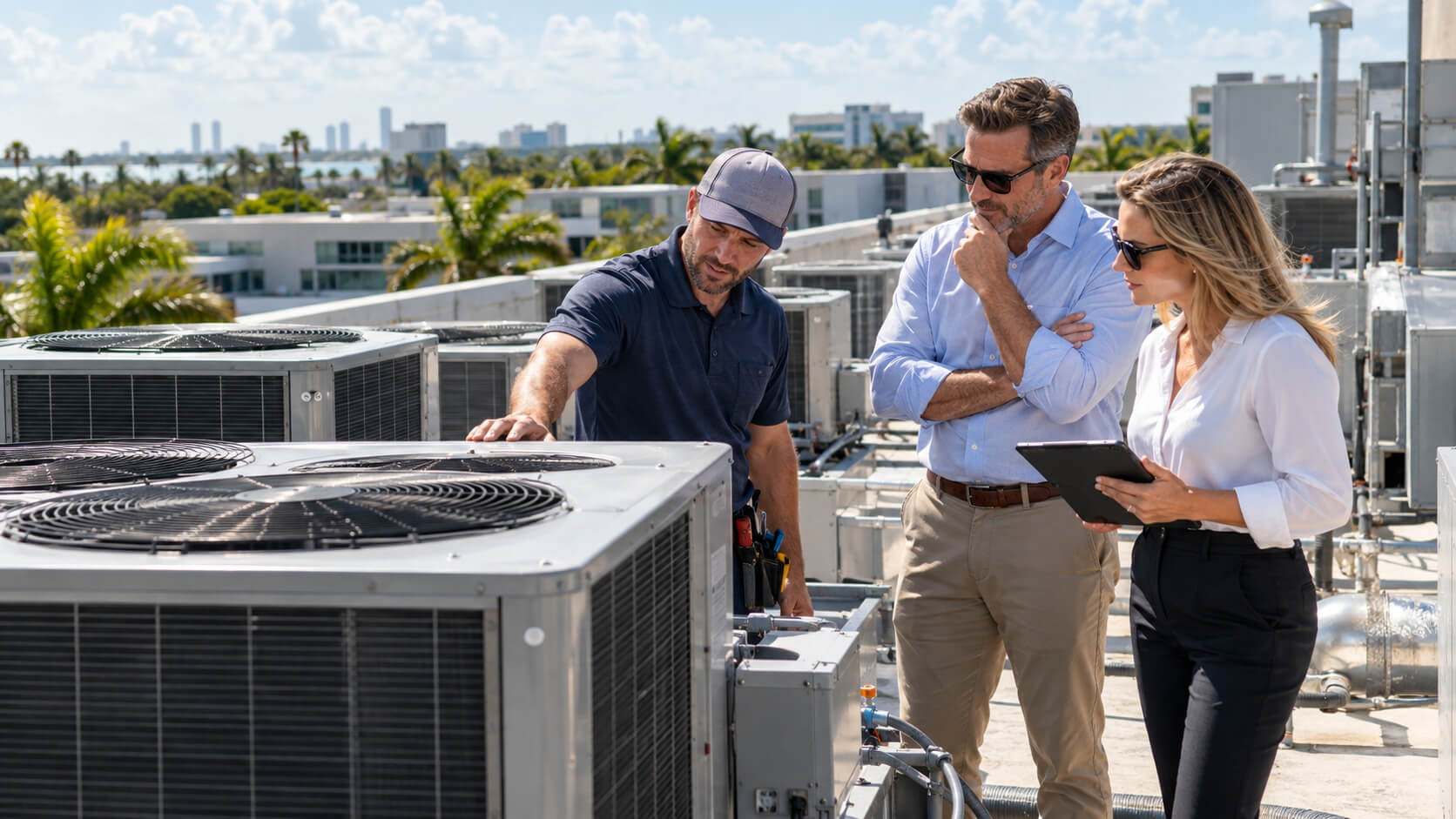
Commercial Rooftop HVAC Units remain one of the most practical ways to heat, cool, ventilate, and manage comfort in many commercial buildings. Restaurants, retail stores, offices, schools, hospitality properties, medical facilities, and multi-unit buildings often need equipment that can operate for long hours while remaining accessible for servicing and keeping valuable indoor floor space clear. That is exactly where rooftop units, commonly called RTUs, fit.
However, choosing commercial HVAC equipment in 2026 involves much more than selecting a tonnage and placing a box on the roof. Modern businesses have to consider efficiency, humidity, ventilation, controls, refrigerant technology, maintenance access, operating schedules, redundancy, and long-term serviceability.
All In One AC provides commercial HVAC installation, replacement, repair, maintenance, ductwork, refrigeration, VRF and related mechanical services across Florida. This guide explains ten important types and configurations of Commercial Rooftop HVAC Units and how businesses can evaluate them.
Table of Contents
What Are Commercial Rooftop HVAC Units?
A rooftop HVAC unit combines multiple heating, cooling, airflow, and control components into a packaged cabinet that is typically installed on a commercial roof.
Depending on the application, an RTU may contain:
- Compressor
- Condenser coil
- Evaporator coil
- Supply fan
- Filters
- Heating components
- Refrigerant controls
- Electrical controls
- Economizer
- Outdoor air components
- Sensors
- Communication hardware
Ductwork carries conditioned air between the rooftop equipment and occupied areas below.
Because major components are located outdoors, technicians can often service the equipment without entering customer-facing or employee work areas.
Why Businesses Use Rooftop HVAC Systems
RTUs offer several practical advantages.
They Preserve Interior Space
Mechanical equipment does not occupy valuable retail, storage, office, or production space.
They Allow Centralized Service Access
Multiple units can often be inspected from the roof.
They Can Serve Different Zones
A commercial building may use separate RTUs for dining areas, kitchens, offices, retail zones, tenant suites, or other spaces.
They Are Available in Many Configurations
Businesses can choose equipment according to heating requirements, energy priorities, ventilation needs, control strategy, and building design.
For commercial installation and repair support, All In One AC provides dedicated commercial HVAC services.
1. Cooling Only Rooftop Units
Cooling-only units are designed primarily for air conditioning applications in buildings where separate heating is available or heating demand is limited.
They can be appropriate for certain warm-climate applications where cooling is the dominant load.
The important considerations include:
- Cooling capacity
- Part-load efficiency
- Airflow
- Humidity performance
- Ventilation requirements
- Controls
- Maintenance access
In South Florida, humidity control is particularly important because simply lowering temperature does not always create comfortable indoor conditions.
2. Packaged Heat Pump Rooftop Units
Packaged heat pump RTUs provide cooling and electric heating through the refrigeration cycle.
Instead of generating heat through combustion during normal heat-pump operation, the system transfers heat.
For many Florida properties, where winter heating demand is relatively moderate compared with cooling demand, heat-pump rooftop systems can be an attractive option.
The correct selection still depends on the building, electrical infrastructure, operating hours, occupancy, and design conditions.
3. Gas Electric Packaged Rooftop Units
Gas electric RTUs combine electric air conditioning with gas-fired heating.
They are common in commercial applications where gas infrastructure is available and the building design calls for this arrangement.
Businesses considering replacement should evaluate more than whether a new unit physically matches the old one.
Important questions include:
- Is the existing capacity correct?
- Are duct conditions acceptable?
- Has occupancy changed?
- Has the building been renovated?
- Are ventilation requirements different?
- Can controls be improved?
- Is the curb compatible?
- Does the electrical and gas infrastructure support the replacement?
A like-for-like replacement is not always the same thing as an optimized replacement.
4. Variable Speed Rooftop Units
Traditional HVAC equipment may operate primarily at fixed stages.
Variable-speed technology can adjust output more closely to the actual building load.
That can provide advantages such as:
- More stable temperatures
- Longer operation at lower capacity
- Improved part-load performance
- Better humidity management
- Reduced abrupt cycling
- Quieter operation in some applications
Commercial buildings rarely operate at exactly the same load all day.
Occupancy, solar exposure, kitchen activity, doors opening, weather, equipment loads, and business hours all change.
Variable operation can help the HVAC system respond more closely to those changing conditions.
5. Multi Stage Rooftop Units
Multi-stage equipment provides an intermediate approach between simple single-stage operation and fully variable systems.
Instead of operating only at full capacity, the unit can use different output stages based on demand.
This can improve comfort and part-load performance without necessarily requiring the most advanced equipment available.
The best configuration depends on lifecycle cost, application, operating schedule, controls, and maintenance strategy.
6. High Efficiency Rooftop Units
Efficiency matters greatly for equipment that may operate thousands of hours each year.
Commercial HVAC buyers should compare equipment using the efficiency metrics relevant to the size and type of unit rather than relying on marketing terms such as “high efficiency” alone.
In addition to rated performance, actual operating cost is influenced by:
- Correct sizing
- Duct leakage
- Building envelope
- Thermostat schedules
- Maintenance
- Filter condition
- Coil condition
- Ventilation load
- Occupancy
- Outdoor temperature
- Control setup
Efficient equipment installed into a poorly performing distribution system may never deliver the expected result.
7. Economizer Equipped Rooftop Units
An economizer can use favorable outdoor conditions to reduce the amount of mechanical cooling required.
The basic idea is simple: if outside air conditions are suitable, the system can bring in more outdoor air instead of relying entirely on compressor-based cooling.
However, economizer operation has to be properly controlled.
Florida’s humidity means outdoor air conditions are not always favorable simply because the temperature seems mild.
Sensors, dampers, control logic, commissioning, and maintenance all matter.
A malfunctioning economizer can create comfort or energy problems rather than solve them.
8. Smart and Building Automation Ready RTUs
Commercial HVAC controls have become increasingly important.
A business may benefit from functions such as:
- Occupied and unoccupied schedules
- Temperature setback
- Remote monitoring
- Equipment alarms
- Runtime tracking
- Zone coordination
- Maintenance notifications
- Trend data
- Fault diagnostics
A sophisticated controller cannot compensate for failed mechanical equipment, but good controls can help the building operate more intelligently.
For multi-unit properties, visibility into equipment operation can also help facility teams prioritize service.
9. Rooftop Units Integrated With Dedicated Ventilation
Some commercial spaces have substantial outdoor-air requirements.
Restaurants, schools, medical environments, gyms, and high-occupancy spaces may have ventilation needs that deserve specific design attention.
In certain applications, outdoor air treatment may be coordinated with a dedicated ventilation or dehumidification strategy instead of expecting a standard RTU to handle every moisture and ventilation condition by itself.
The right design depends on building use and applicable project requirements.
10. Rooftop Systems Designed for Multiple Zones or Multiple Units
Many larger commercial properties do not depend on one rooftop unit.
They use several units serving different sections of the building.
This can make zoning and scheduling more flexible while also creating opportunities for redundancy.
A restaurant, for example, may have very different HVAC loads in:
- Kitchen areas
- Dining spaces
- Offices
- Storage
- Waiting areas
Retail buildings, schools, hotels, and multi-tenant properties have their own load patterns.
All In One AC has experience with multiple commercial environments and showcases examples of completed work in its HVAC project portfolio.
What Is Changing in Commercial HVAC in 2026?
Lower GWP Refrigerants
The HVAC market is transitioning toward refrigerants with lower global warming potential.
This affects equipment design, installation practices, tools, technician training, replacement planning, and service procedures.
Building owners replacing older equipment should ask what refrigerant the proposed system uses and how that choice may affect future service.
Better Part Load Performance
A commercial building does not remain at maximum load all day.
Equipment capable of responding efficiently to partial demand is increasingly valuable.
Smarter Diagnostics
Modern control systems can provide more operating information to technicians and facility managers.
This can make troubleshooting faster when the system and controls are properly configured.
Greater Attention to Ventilation and Humidity
Businesses increasingly expect HVAC systems to manage more than temperature.
Humidity, ventilation, indoor comfort, and air distribution all influence how occupants experience the building.
Lifecycle Thinking
The cheapest equipment purchase is not always the lowest-cost choice over the life of the system.
Businesses should evaluate:
- Installation cost
- Energy use
- Maintenance requirements
- Parts availability
- Controls
- Warranty
- Serviceability
- Downtime risk
- Expected operating life
How Rooftop HVAC Units Improve Business Efficiency
HVAC efficiency is not only about electricity.
Reliable HVAC can support business operations in several ways.
Better Employee and Customer Comfort
Comfort affects how people experience restaurants, shops, offices, hotels, and service businesses.
Reduced Emergency Downtime
Preventive maintenance can help identify developing issues before they become disruptive failures.
Easier Service Planning
Accessible rooftop equipment may allow repairs without requiring technicians to work in busy customer areas.
More Accurate Scheduling
Smart controls can reduce unnecessary operation during unoccupied periods.
Better Zone Management
Multiple RTUs can allow different parts of the building to operate according to their actual needs.
Warning Signs a Commercial RTU Needs Service
Property managers should pay attention to:
- Rising energy consumption
- Repeated breaker trips
- Unusual compressor noise
- Weak airflow
- Hot or cold zones
- Excessive indoor humidity
- Water leaks
- Short cycling
- Constant operation
- Fault alarms
- Frequent repair calls
- Visible coil contamination
All In One AC provides commercial service and repair support focused on identifying the underlying cause instead of repeatedly applying temporary fixes.
Preventative Maintenance for Commercial Rooftop Units
Commercial systems often operate longer hours and under heavier loads than residential equipment.
Maintenance may involve:
- Filter inspection and replacement
- Coil inspection
- Drain cleaning
- Belt inspection where applicable
- Fan and motor checks
- Electrical inspection
- Refrigerant circuit evaluation
- Control verification
- Economizer inspection
- Airflow measurement
- Temperature checks
- Cabinet inspection
The correct maintenance schedule depends on building use, environmental conditions, operating hours, and equipment type.
A restaurant system may need a different level of attention than an office that operates five days per week.
Repair or Replace a Commercial Rooftop Unit?
Replacement may deserve consideration when:
- Breakdowns are becoming frequent
- Major components are failing
- Capacity no longer matches the building
- Controls are obsolete
- Parts availability is becoming difficult
- Efficiency is poor
- The property is being renovated
- Business requirements have changed
Repair may still make sense when the equipment is otherwise sound and the failure can be corrected economically.
A professional assessment should consider the total condition of the system rather than equipment age alone.
Why Commercial Clients Work With All In One AC
All In One AC works with light and mid-size commercial HVAC applications across Florida.
Services include:
- Rooftop unit installation
- System replacement
- HVAC repair
- Preventative maintenance
- Ductwork fabrication and installation
- VRF and VRV systems
- Chiller systems
- Walk-in coolers and freezers
- Commercial refrigeration
The company has experience with restaurants, schools, veterinary clinics, hotels, retail environments, multi-unit properties, and other commercial settings.
You can learn more about the company’s background on the Visit Now.
Questions to Ask Before Choosing an RTU
Before approving equipment, ask:
- How was the required capacity determined?
- What efficiency rating applies to the proposed unit?
- How will humidity be managed?
- What refrigerant does the system use?
- Does the existing curb need modification?
- Is existing ductwork adequate?
- What ventilation strategy is required?
- What controls are included?
- How easy is the unit to service?
- What maintenance schedule is recommended?
- What warranty applies?
- How will installation affect business operations?
Those questions often reveal more than simply comparing equipment prices.
Conclusion
Commercial Rooftop HVAC Units continue to be a flexible solution for businesses that need reliable heating, cooling, ventilation, and centralized mechanical equipment.
In 2026, the strongest commercial HVAC strategy goes beyond selecting a unit with the highest advertised efficiency.
System sizing, part-load operation, refrigerant technology, controls, humidity, ductwork, maintenance access, ventilation, and long-term serviceability all matter.
Whether you manage a restaurant, retail property, office, hotel, school, veterinary facility, or multi-unit building, All In One AC can help evaluate the system as a complete mechanical solution.
For commercial installation, maintenance, repair, or replacement assistance, contact us.
FAQs
1. How long do Commercial Rooftop HVAC Units last?
There is no single lifespan for every RTU. Equipment quality, installation, operating hours, environment, maintenance, controls, and workload can all significantly affect useful service life.
2. Are rooftop HVAC units more efficient than split systems?
Not automatically. Efficiency depends on the equipment, application, control strategy, installation, duct system, building load, and maintenance. The best system is the one properly matched to the commercial property.
3. How often should a commercial rooftop unit be maintained?
Maintenance frequency depends on equipment type, operating hours, property use, environmental exposure, and manufacturer requirements. High-use commercial systems often need more frequent inspection than lightly used equipment.
 Heading Sub Title
Leave a Reply